My first experience working with dev teams was centralizing our internal operations and course enrollment data via Salesforce. One day I was walking a colleague through our workflows, deep in the terminology, when she stopped me: “Hold on. Explain it to me like I’m five.”
Her request to ELI5 had nothing to do with intelligence and everything to do with catering the messaging to my audience: translate the work into words she could follow, so she could understand it and then communicate it out in her own way. I’ve been grateful for that advice ever since.
It applies to everything
I once knew of someone at another workplace who was very talented and knew their business inside and out. The trouble is — they also made sure YOU knew it. Whether they were aware of it or not — they always projected an air of condescension, and they seemed to relish being the expert in the room. Instead of lifting people up, they made sure everyone knew their place in the pecking order. As a result, no one wanted to work with them, and it made cross-functional collaboration quite challenging. All that knowledge was valuable, and very little of it landed, because it never got translated for the people who needed it.
I think about that person whenever I see AI training and implementation. Being an expert in AI is great. If you can’t speak University though, the odds that a team adopts what you recommend are slim.
Workflows and people first, then the tech
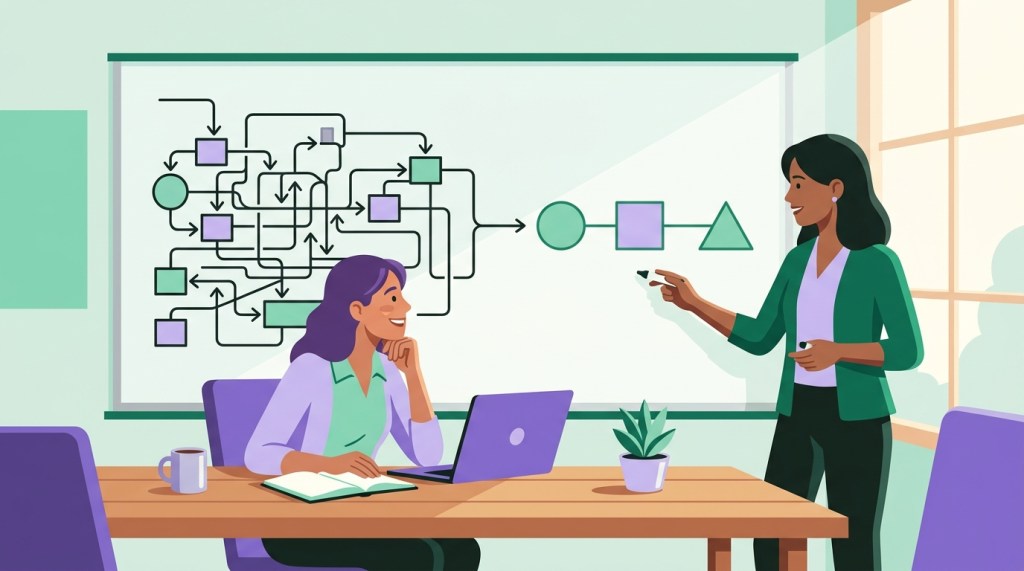
Universities and corporations work very differently, and a solution that works in a corporation won’t necessarily work on a campus. Many workflows are hard to change because of the intangible pieces baked into how a process became institutionalized. Those pieces need to be worked through before AI can help anything scale.
As someone who’s worked in Higher Ed my whole career, I like to start with questions that bring those pieces to the surface, and then we wrestle with them together. We transform the workflow first and bring in the technology after. Otherwise it’s just slapping an “easy button” on a process nobody has examined (I wrote more about that in AI Is Not an Easy Button). Honestly, this groundwork is half the work, and often more.
I saw a small version of this when I built my free interview practice tool. I spent hours up front describing who it was for, and users still told me it leaned toward executive roles, because the questions reflected the interviews I’d been through. So I went back and added a broader range of questions for different roles and career stages. Listening to the people it was built for made it better.
Why I do this work
I’m a higher ed operations SME who has learned to put AI to work hands-on, and I’ve run these operations for universities myself. I speak University, I speak AI, and my job is to translate between the two. Workflows and people first, tech second.
If your team is ready to start with the workflow, I’d love to talk it through with you. Book a free 30-minute call and we’ll start with the questions that bring your workflow to the surface.
Try it: Not sure which workflow to start with? My free Automation Opportunity Finder helps you list your team’s repeat tasks, then shows the hours at stake, the quick wins and how to automate each.

